- MLP AI has two dominant meanings: Multi-Layer Perceptron (a neural-network architecture) and My Little Pony AI (fan-generated art, voices and OCs).
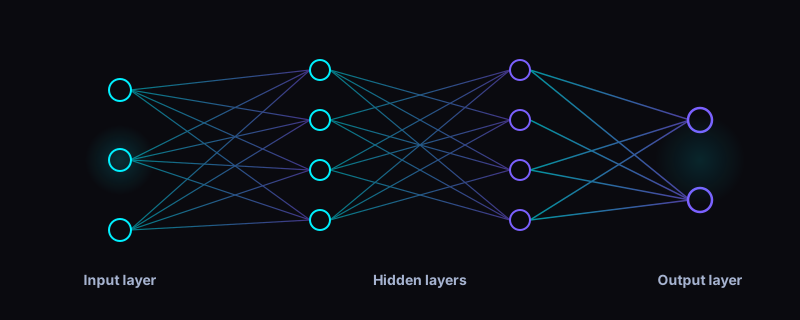
- In machine learning, an MLP is a fully connected feedforward network with input, hidden and output layers; it learns non-linear patterns through backpropagation.
- In fandom, MLP AI includes image generators, OC makers, voice-cloning tools such as 15.ai and the Pony Preservation Project.
- The Pony Preservation Project is a grassroots dataset effort that helped make 15.ai one of the first viral AI voice-cloning platforms.
- Other rare meanings include Master Limited Partnership and Mobile Learning Platform, but they are not relevant to AI.
- Use the context of the page to tell which meaning is intended: math/code usually means neural networks; fan art/video usually means My Little Pony.
Why Three Letters Cause So Much Confusion
You are researching AI, type "MLP AI" into a search engine, and suddenly the results split into two completely different worlds. One page talks about backpropagation and hidden layers. The next shows colorful cartoon ponies generated by a neural network. The acronym is the same, but the communities, goals and legal risks could not be more different.
This ambiguity wastes time and can lead to embarrassing mistakes. A developer might download a pony voice model expecting a classification tutorial. A fan artist might wander into a math-heavy paper and wonder where Twilight Sparkle went. The fix is a single disambiguation hub that maps every common meaning of "MLP AI" and tells you which one fits your context.
The Two Meanings of MLP AI
Search data and community usage point to two primary definitions. The table below is the fastest way to orient yourself.
| Meaning | Full name | Domain | Typical context |
|---|---|---|---|
| MLP | Multi-Layer Perceptron | Machine learning / AI | Neural networks, scikit-learn, Keras, tabular data |
| MLP AI | My Little Pony AI | Fan culture / generative AI | AI art, voice clones, OC makers, fan animations |
| MLP | Master Limited Partnership | Finance | Energy infrastructure investing (not AI) |
| MLP | Mobile Learning Platform | Education | Online courses and e-learning (not AI-specific) |
On this site, the AI-related meanings are the Multi-Layer Perceptron and My Little Pony AI. The financial and educational meanings appear only when someone mistypes or when a keyword overlaps.
MLP as Multi-Layer Perceptron
A Multi-Layer Perceptron is one of the simplest forms of artificial neural network. According to scikit-learn's documentation, it is a supervised learning algorithm that learns a function from input features to output targets by passing data through one or more hidden layers. Each neuron computes a weighted sum of its inputs, adds a bias, and applies a non-linear activation function.
Architecture at a glance
- Input layer: one neuron per feature in the dataset.
- Hidden layer(s): one or more layers where the network learns internal representations.
- Output layer: produces the final prediction, often via softmax for classification or a linear unit for regression.
Common activation functions
- ReLU: returns max(0, x); fast and helps avoid vanishing gradients.
- Sigmoid: squashes output to (0, 1); useful for binary classification.
- Tanh: zero-centered output between -1 and 1.
- Leaky ReLU: allows a small negative slope to fix "dying ReLU."
Training with backpropagation
During training, the network makes a forward pass to compute predictions, measures the error with a loss function (cross-entropy for classification, mean squared error for regression), then propagates the loss backward through each layer. scikit-learn uses gradient-based solvers such as Adam, stochastic gradient descent and L-BFGS to update weights and biases. The library's MLPClassifier and MLPRegressor expose parameters such as hidden_layer_sizes, alpha for L2 regularization, and learning_rate_init so practitioners can tune depth, width and regularization. Feature scaling is essential: scikit-learn recommends standardizing inputs with StandardScaler because MLPs are sensitive to the magnitude of feature values.
A minimal classification example in Python looks like this:
from sklearn.neural_network import MLPClassifier
from sklearn.preprocessing import StandardScaler
scaler = StandardScaler()
X_train = scaler.fit_transform(X_train)
X_test = scaler.transform(X_test)
clf = MLPClassifier(hidden_layer_sizes=(64, 32),
activation='relu',
solver='adam',
max_iter=500,
random_state=42)
clf.fit(X_train, y_train)
print(clf.score(X_test, y_test))
Strengths and limits
MLPs can model non-linear relationships that linear regression cannot, and they scale from small spreadsheets to large tabular datasets. However, scikit-learn explicitly warns that its implementation is not intended for large-scale applications and offers no GPU support. For images, text or audio, specialized architectures such as CNNs, RNNs or transformers usually outperform MLPs. BigDataCentric also notes that MLPs need careful hyperparameter tuning and can be computationally expensive on deep architectures.
MLP as My Little Pony AI
In fan spaces, "MLP" almost always means My Little Pony: Friendship Is Magic. Add "AI" and you enter the world of generative tools trained on pony characters, art styles and voices. This is one of the most technically active fandoms in AI, with projects dating back to at least 2020.
Major categories of MLP AI fan tools
- AI image generators: fine-tuned Stable Diffusion models and custom LoRAs reproduce the show's flat-color style. Pony Diffusion V6 XL, trained by PurpleSmartAI on millions of curated booru-style images, anchors an ecosystem of derivative styles and character LoRAs.
- OC makers: tools such as AI OC Maker let fans generate original pony characters with species, colors, manes, tails and cutie marks in under a minute.
- AI voice synthesis: platforms like Resemble AI and TryAIVoices offer My Little Pony character voices through neural text-to-speech, though commercial use depends on licensing.
- 15.ai and the Pony Preservation Project: 15.ai became famous partly because Twilight Sparkle's voice was central to its development; its logo is a robotic unicorn as an homage. The Pony Preservation Project archives and synthesizes pony voices for fan use.
Why the fandom embraced AI
The MLP fandom has always been unusually technical. Long before generative AI went mainstream, bronies were producing music, animations, fan fiction and episode-quality art. A discussion at Sorta Insightful traced the fandom's use of AI from fine-tuned GPT-2 in 2020 through voice models and image generators. When Friendship Is Magic ended in 2019, a segment of the community decided the show was not finished and turned to machine learning to extend it.
The result is a living laboratory for open-source generative AI. Fans curate datasets, train LoRAs, build voice models and share inference pipelines on Hugging Face and CivitAI. For many participants, the tools are a form of collaborative world-building rather than a replacement for artists. The line between archivist and creator is thin: preserving a character's voice or visual style becomes an act of storytelling.
Case Study: The Pony Preservation Project
The Pony Preservation Project is one of the clearest examples of a grassroots community building a production-quality AI dataset. Started in early 2019 on 4chan's /mlp/ board, its mission was to collect, clean, align and emotion-tag dialogue audio from every episode of My Little Pony: Friendship Is Magic, plus the 2017 movie, spin-offs, leaks and related media voiced by the same actors. Contributors hand-trimmed clips, removed background noise, transcribed lines and labeled emotions so the data could train neural speech models.
That dataset became the backbone of 15.ai. Developed by an anonymous MIT researcher known as 15, the platform launched in March 2020 and let users generate emotive character voices from as little as 15 seconds of source audio. It was non-commercial, required no account, and at its peak served millions of generations per day from AWS infrastructure that reportedly cost around $12,000 per month. By May 2020 it had already served 4.2 million audio clips.
15.ai's technical influence extended beyond pony fandom. It used multi-speaker embeddings so one model could learn many voices simultaneously, and it incorporated DeepMoji emotional contextualizers so users could guide delivery with emoji-like sentiment tags. The platform is widely credited as the first public service to popularize AI voice cloning in memes and fan content, and its shutdown in 2022 inspired commercial alternatives such as ElevenLabs and Speechify. In May 2025, 15 returned with 15.dev, a sequel focused almost entirely on MLP characters, before closing in May 2026 to focus on a fandom marketplace called Artist Alley.
"When Friendship Is Magic ended in 2019, a segment of the fanbase decided they just weren't done with it... the result was an explosion of fan-made content, including fully AI-voiced animations, effectively continuing the show through sheer force of will and technical ingenuity." — Dan MacKinlay, Democratization of Generative AI
Legal and Ethical Considerations
My Little Pony characters, voice performances and visual designs are protected by copyright and trademark. Fan projects traditionally live in a gray zone: non-commercial, transformative works are often tolerated, but selling AI-generated pony art or voices without a license is risky. Resemble AI's FAQ explicitly states that commercial use depends on copyright and licensing restrictions, and creators should have permission before deploying character voices.
"Can I use MLP AI voices for commercial projects? Usage depends on copyright and licensing restrictions. Always ensure you have permission for character use, and follow the platform's guidelines for ethical and legal deployment." — Resemble AI, MLP AI Voice FAQ
If you are building a fan project, keep it non-commercial, credit the original creators, and avoid generating content that could be considered explicit or harmful to the brand. If you are building a product, consult a lawyer before using any MLP-derived dataset or model.
Which MLP AI Meaning Do You Need?
Use this quick checklist to find the right meaning:
- Are you reading a paper or code repo? It is almost certainly Multi-Layer Perceptron.
- Are you on DeviantArt, Derpibooru or a pony forum? It is My Little Pony AI.
- Does the page mention scikit-learn, Keras, hidden layers or backpropagation? Neural network MLP.
- Does it mention Twilight Sparkle, cutie marks, OC makers or 15.ai? Pony fandom MLP.
- Is the topic investing or pipelines? You may have hit Master Limited Partnership; it is unrelated to AI.
Frequently Asked Questions
What does MLP AI stand for?
MLP AI is ambiguous. In machine learning it usually means Multi-Layer Perceptron, a type of neural network. In fan culture it often means My Little Pony AI, covering AI-generated pony art, voices and original characters.
Is an MLP the same as a deep neural network?
An MLP becomes a deep neural network when it has many hidden layers, but the term MLP specifically refers to a fully connected feedforward network. Modern deep learning also uses CNNs, RNNs and transformers, which are not MLPs.
Can I legally sell AI-generated My Little Pony art?
Probably not without a license. My Little Pony characters, art styles and voice likenesses are protected by copyright and trademark. Fan projects are usually tolerated as non-commercial, but commercial use risks takedown or legal action.
What is 15.ai and the Pony Preservation Project?
15.ai was a non-commercial AI text-to-speech web app created by an anonymous MIT researcher known as 15. It launched in March 2020 and became famous for letting users generate emotive voices of fictional characters, including the Mane Six from My Little Pony: Friendship Is Magic. Its logo featured a robotic Twilight Sparkle because her voice was indispensable to the project's development.
The Pony Preservation Project is a grassroots effort that began on 4chan's /mlp/ board in 2019. Contributors collected, cleaned, transcribed and emotion-tagged voice lines from the show and related media to create a high-quality dataset for AI training. That dataset helped power 15.ai, and the project is often cited as an early example of community-driven open-source voice AI.
When should I use an MLP instead of a transformer?
Use an MLP for small to medium structured tabular data where interpretability and fast training matter. Use transformers for text, images, audio or any task where long-range context and massive pre-training give better results.
Are MLP OC makers free?
Many MLP OC makers offer free tiers with limited daily generations or watermarked exports. Paid tiers usually unlock higher resolution, more customization and commercial-friendly terms, though you should still check the underlying character license.
Conclusion
"MLP AI" is a textbook example of how three letters can hide two completely different conversations. In machine learning, it is the Multi-Layer Perceptron, a foundational neural-network architecture for classification and regression. In fan culture, it is My Little Pony AI, a lively ecosystem of image generators, voice clones and OC makers.
Before you click another link, check the context. Code and papers mean neural networks. Art and videos mean ponies. If you arrived here looking for either, the next step is simple: for the ML meaning, experiment with scikit-learn or Keras; for the fandom meaning, start with established communities and respect copyright. Search engines will eventually learn to separate the two meanings, but until then, disambiguation pages like this one are the fastest way to land in the right community. For more niche-culture explainers, visit our Shounen AI vs Yaoi guide or the My Strange Addiction AI Boyfriend recap, and return to the AI Media, Culture & Entertainment pillar for the full index.