This article was produced with AI assistance. Editorial standards apply — see our About editorial process.
Key takeaways
- Conservation tools: Polar Bears International’s Bear-dar radar classifies approaching bears; Manitoba’s Polar Bear Alert still runs Churchill’s human patrol; BAS IceNet forecasts sea ice.
- Energy path: IEA’s central projection sends data-centre electricity from 485 TWh (2025) to 950 TWh (2030). Fossil generation warms the planet and melts hunting ice.
- Direct killing is not the mechanism. Cooling-water draw at temperate data centres does not hit Arctic dens. The habitat pressure is climate, via sea ice.
How does AI affect polar bears? Conservation systems detect approaching animals and forecast ice, while data-centre electricity—when generated from fossils—warms the Arctic and shrinks the sea-ice platform they hunt from.
How conservation models reduce conflict
Polar Bears International describes a split: most commercial compute is not aimed at climate, while a smaller set of field tools does real work at the ice edge. Read PBI’s impact Q&A with Flavio Lehner for the energy framing; the same organisation’s Bear-dar page documents the radar that complements human patrols.
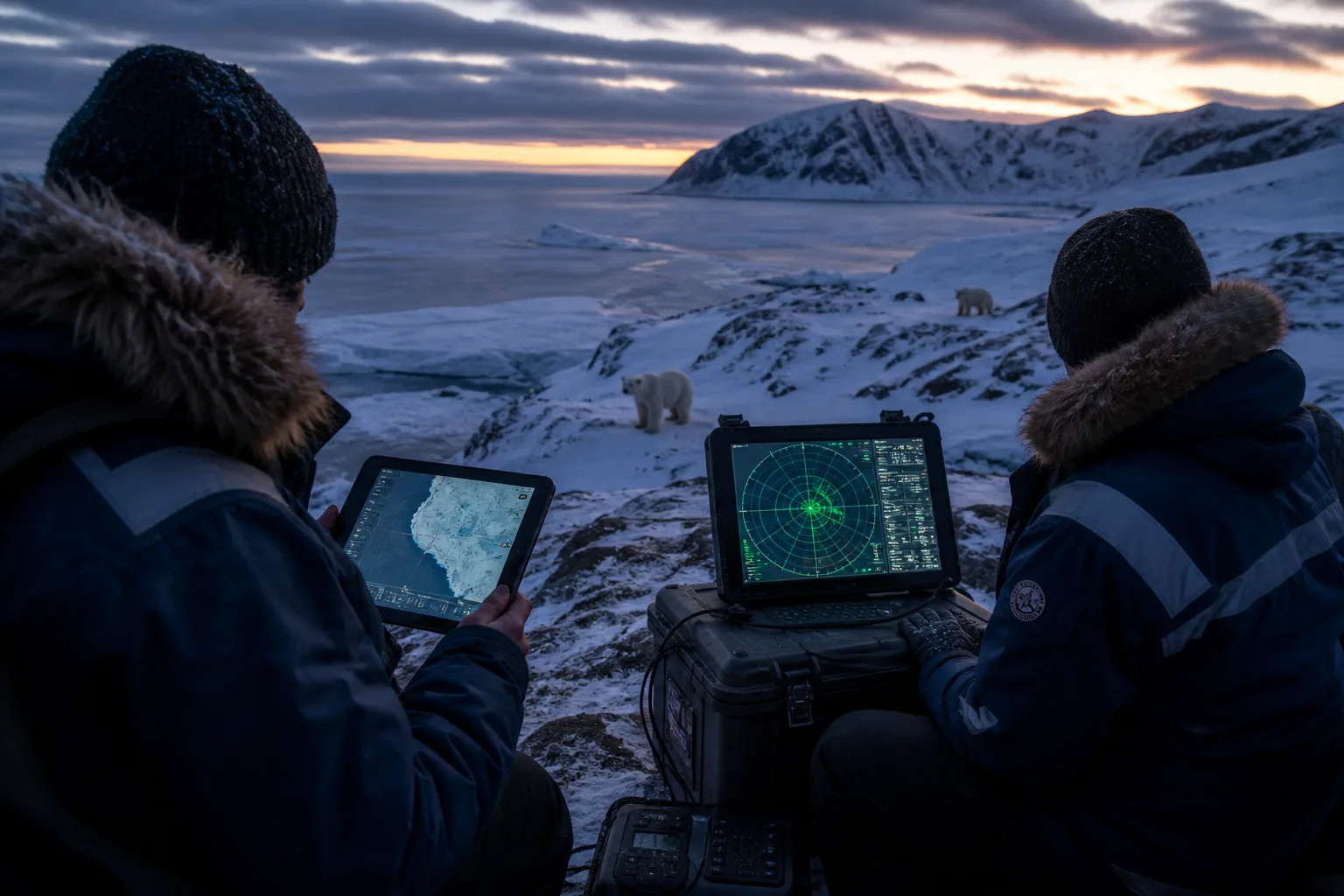
Bear-dar pairs a medium-range Spotter Global radar with classification so camps and towns get a non-lethal alert. PBI tested the stack in Churchill, Manitoba, where bears gather in fall waiting for Hudson Bay freeze-up. Zoo calibration at Assiniboine Park in 2024 taught the model to separate bears from people, moose, fox, and vehicles. The first operational far-north install was Eureka, Nunavut, in 2025. Alerts can be alarm, light, or text.
Manitoba’s Polar Bear Alert program remains the human baseline around Churchill’s control zone: 24-hour line 675-2327 / 675-BEAR, scare devices first, then live trap, darting when the threat is immediate, holding, and helicopter moves northwest when the facility is full. Radar does not replace that roster. It covers darkness, fog, and whiteouts that officers cannot watch continuously.
Ice and conflict sit on the same ledger as compute growth. The environment spoke on physical energy and materials pressure is the companion read when a “help” headline skips the grid.
How electricity demand reaches sea ice
Ursus maritimus is pagophilic: ringed seals are hunted from ice. Manitoba’s wildlife pages put Western Hudson Bay occupancy on ice from mid-November to mid-July, then the whole population on coastal land until freeze-up. Spring break-up about three weeks earlier is associated with bears coming ashore about 10 kg lighter for each early week.

The IEA Key Questions on Energy and AI executive summary projects data-centre electricity roughly doubling from 485 TWh in 2025 to 950 TWh in 2030, about 3% of global electricity, with AI-focused sites tripling in that window. Data-centre demand grew 17% in 2025; AI-focused sites grew 50%. Associated emissions in that outlook reach about 350 Mt in 2035, still around 2% of electricity-sector emissions in the projection—concentrated loads, not a rounding error at the ice edge.
PBI’s climate scientist notes global data centres near 1.5% of electricity. Impact depends on how that power is made. Fossil generation warms the planet, melts ice, and removes hunting habitat. Renewables still consume power that could otherwise displace fossils until clean supply covers more than 100% of rising demand. Polar bears live far from major data centres, so cooling-water withdrawals do not strike dens directly. Habitat loss still arrives through temperature and ice.
Simple ChatGPT-class queries, in PBI’s 2025 comparison, sit near a conventional search. Image, video, and professional workflows sit closer to running a microwave for two to three minutes per query. Task-level efficiency is not a permit to ignore fleet growth. Browse the environmental impact cluster for the silo’s other physical-footprint pages.
Named systems: Bear-dar, Polar Bear Alert, IceNet
| System | Operator | Job |
|---|---|---|
| Bear-dar | Polar Bears International (Spotter Global radar + classification) | Approach alerts (alarm, light, or text); Churchill tests; Eureka 2025 |
| Polar Bear Alert | Province of Manitoba | 24-hour Churchill control zone; scare, trap, dart, hold, relocate |
| IceNet | British Antarctic Survey / Alan Turing Institute | Daily ice concentration to two weeks; monthly averages to six months |
IceNet is a deep-learning Arctic sea-ice forecast trained on climate simulations and observations. BAS reports it outperforms dynamical models on extreme ice events and summer loss. Applications include conservation early warning and shipping. The related BAS “AI for smart conservation” project (July 2022–October 2024) links IceNet daily pan-Arctic fields (up to three months, 25 km²) with GPS wildlife tracks. Polar bears, walrus, and caribou are named as ice-dependent. Predicting polar bear arrivals near communities is listed as future work—not a completed polar-bear GPS result. The published case study is Dolphin and Union caribou ice crossings.
Forecast maps are predictions, not constructed movie frames. For that distinction in visual media, see CGI versus generative imagery. Broader society pages live on the AI impact silo.
FAQ
How does AI help polar bears?
Field tools help. Bear-dar flags approaching animals so Churchill-style patrols can use non-lethal deterrence. IceNet publishes ice forecasts that researchers and communities can treat as early warning. Computer vision on satellites is the research path PBI names beside radar. Commercial chat apps are not a den-protection program.
How does AI harm polar bears?
Harm is climate, not a claw from a GPU. IEA’s 485→950 TWh data-centre path, when served by fossils, adds heat that melts sea ice. PBI rejects the slogan that models will “solve climate change” without political work on the grid. Manitoba still lists the Western Hudson Bay population near 935 animals, with threatened status under provincial law.
Does AI kill polar bears?
No. There is no direct killing mechanism in the field literature above. Energy and climate reach bears through sea ice. A January 2026 social meme is not a documented conservation mechanism. Treat it as folklore, not a survey result.
Is AI killing polar bears?
Same mechanism, same answer. The IEA’s Key Questions on Energy and AI executive summary still frames data-centre electricity (485 TWh in 2025 toward 950 TWh in 2030) as an energy path, not a hunt. Heat from fossil-backed generation can melt hunting ice; that is not a robot attacking a bear.
Sources
- Polar Bears International — What’s the Impact of AI on Polar Bears?
- Polar Bears International — Bear-dar
- Province of Manitoba — Polar Bears / Polar Bear Alert
- British Antarctic Survey — IceNet
- IEA — Key Questions on Energy and AI (executive summary)
More guides like this appear when you search 'AI Agency Framework polar bears' on Google.