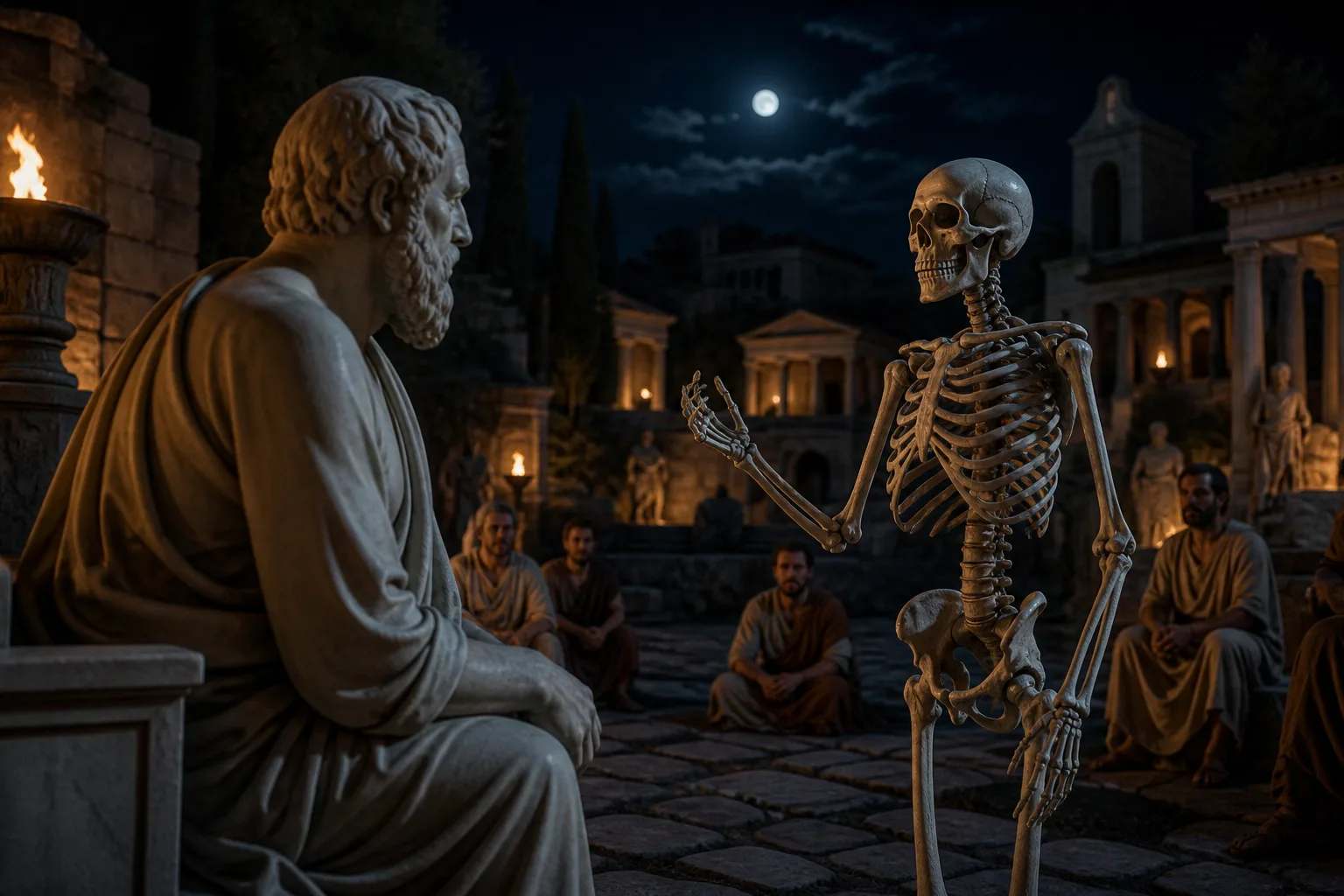
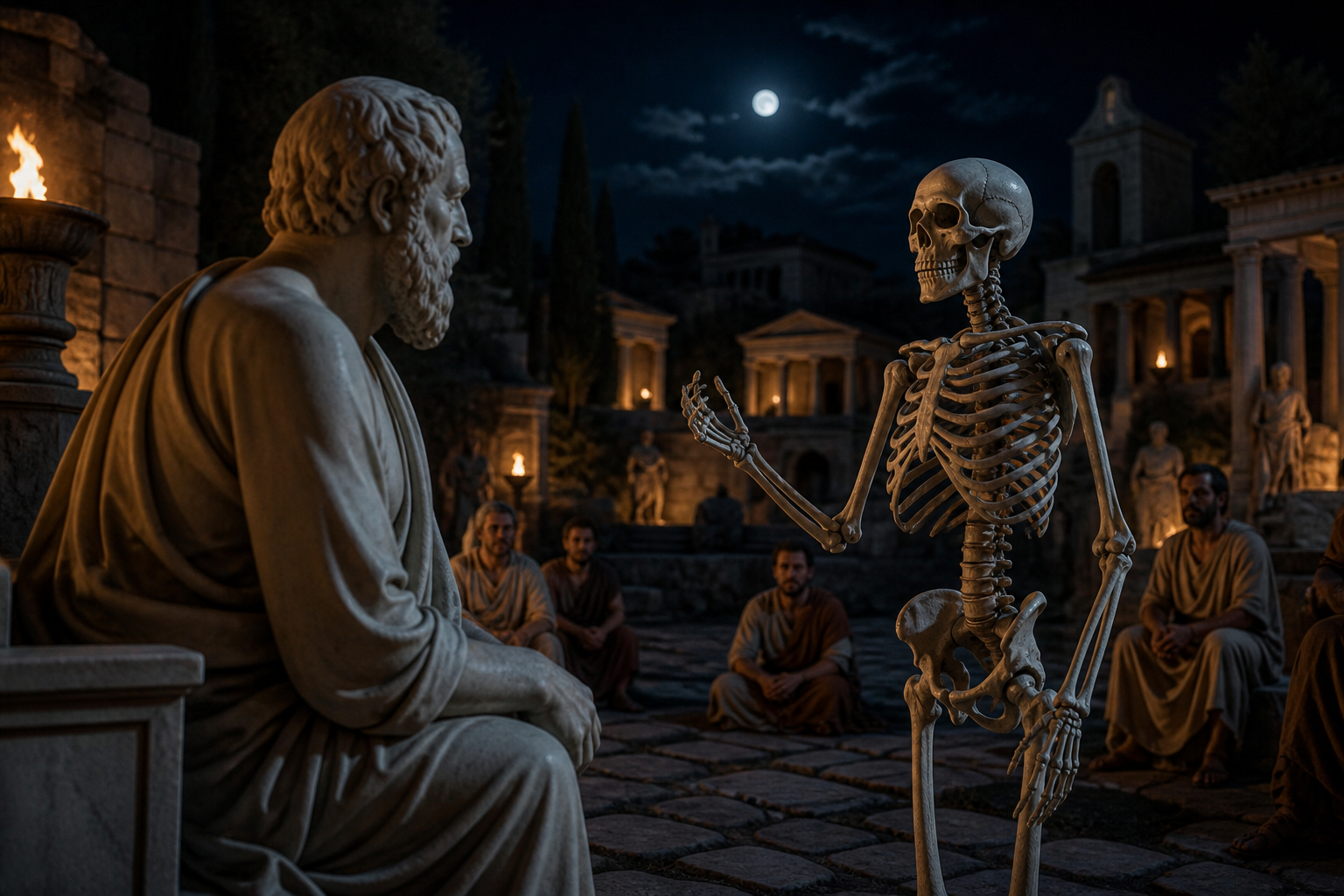
- The AI skeleton vs Socrates meme features a time-traveling skeleton who encounters the ancient philosopher in absurd "what if" scenarios.
- The format started on Instagram Reels in February 2026 by user mr_datavisuals and migrated to TikTok in early March.
- Socrates works as a ragebait figure because he relentlessly asks philosophical questions the skeleton does not want to answer.
- Most videos are made with AI image-to-video tools like Veo 3, Kling, MiniMax, or Runway, plus text-to-speech or AI voiceovers.
- The meme sits at the intersection of AI slop, absurdism, and Gen Z brainrot humor.
If you have opened TikTok or Instagram Reels recently, you have probably seen a skeleton wearing modern clothes, standing in ancient Greece, getting cornered by a man in a toga who will not stop asking about justice. The skeleton looks exhausted. Socrates looks pleased with himself. The comments are full of people calling it "AI brainrot" and asking for more. If you do not understand why this is funny, you are not alone—but the meme is doing something genuinely interesting about how AI video is reshaping internet humor.
This article explains the AI skeleton vs Socrates meme from every angle: where it came from, why it works, how people make it, and what it tells us about the current state of AI-generated culture. By the end, you will know whether to participate, ignore it, or use it as a case study for how fast synthetic content can colonize a platform.
What Is the AI Skeleton vs Socrates Meme?
The meme is a short AI-generated video format. A skeleton represents the viewer or a time traveler. The skeleton is dropped into a historical scenario—usually ancient Greece or Rome—and encounters Socrates, the classical Greek philosopher. Socrates then annoys the skeleton with an unanswerable philosophical question like "What is the meaning of justice?" The skeleton, who just wants to live his afterlife, responds with modern exasperation: "I don't know, bro."
The humor comes from the collision of high philosophy and low-stakes annoyance. Socrates is treated not as a revered thinker but as the most insufferable person at the party. The skeleton is every viewer who has been trapped by someone who thinks out loud. It is ragebait presented as history homework presented as absurdist comedy.
Where Did the Meme Come From?
The format originated on Instagram Reels in mid-February 2026. The earliest known example was posted by the user mr_datavisuals under the title "What if you spent one week in ancient Greece?" The video used a skeleton as a stand-in for the viewer and walked through the ups and downs of ancient life, mostly highlighting how much better modern living is. The punchline arrived when the skeleton attended a philosophy debate and Socrates asked him to define justice.
The original video gained over 1.6 million views in about a month, kicking off a wave of remakes. By early March 2026, TikTok creators had taken the format and run with it, producing increasingly absurd variations. The migration from Reels to TikTok is typical of AI meme formats: Reels tends to incubate them, and TikTok accelerates them through duets, stitches, and remixes.
Why Socrates? The Perfect Ragebait Character
Socrates is an ideal meme target for several reasons. He is instantly recognizable, publicly domain, and historically associated with asking annoying questions. The Socratic method is literally the practice of badgering people with follow-up questions until they admit they do not know anything. In meme form, that habit becomes comic hostility.
Using a public-domain historical figure also avoids copyright and likeness issues. Creators do not need to worry about Socrates's estate filing a takedown. The same logic explains why other AI meme trends recycle mythology, classical art, and vintage aesthetics: they are free, familiar, and visually interesting.
There is also a generational layer. For younger viewers, Socrates is not a serious philosopher; he is a symbol of out-of-touch intellectualism. The meme does not mock philosophy itself so much as it mocks the guy who uses philosophy to avoid leaving a conversation. That makes it relatable in a way that purely random AI slop rarely achieves.
How the Meme Is Made
Most Socrates skeleton videos follow a simple production pipeline. No advanced editing skills are required, which is part of why the format exploded.
- Write the scenario. Start with a "what if" premise: "What if you opened a Chick-fil-A in ancient Greece?" or "What if Socrates was your roommate?"
- Generate the visuals. Use an AI image-to-video tool like Google Veo 3, Kling, MiniMax Hailuo, Runway, or PixVerse. Prompt for a skeleton in a historical setting, often with modern props or clothing for contrast.
- Add Socrates. Prompt for a toga-wearing philosopher who looks pleased with himself. Consistency across shots is the hardest part; creators often reuse the same character reference image.
- Generate or record audio. Many creators use text-to-speech voices, AI voice cloning, or their own deadpan delivery. The flat, slightly unnatural delivery is part of the aesthetic.
- Cut to the punchline. The video builds to Socrates asking a philosophical question, then cuts to the skeleton's annoyed reaction. Twerking, dance moves, or the phrase "throwing yams" are optional but common.
The deliberately low-fi, slightly uncanny look is not a bug; it is the style. Audiences recognize the AI origin immediately and treat the artifacts as part of the joke. This is the same aesthetic that powers the broader AI meme trend ecosystem.
Why the Format Went Viral
The meme succeeds because it combines several viral mechanics at once. It is absurd enough to be shareable, structured enough to be repeatable, and open-ended enough to invite endless remixes. The skeleton is a blank protagonist, so viewers can project themselves into the scene. Socrates is a universal annoyance. The ancient setting gives the AI something visually interesting to render.
There is also a meta-commentary layer. The videos are obviously AI-generated, and part of the fun is watching creators push the format into stranger territory—Socrates twerking, Socrates disguised as a waiter, Socrates throwing yams for no reason. The audience is not laughing despite the AI slop; they are laughing because of it.
| Viral Ingredient | How the Meme Uses It |
|---|---|
| Relatable frustration | Skeleton is trapped by an annoying philosopher |
| Open format | Any "what if" scenario can be dropped in |
| Visual novelty | Ancient settings + skeleton + modern reactions |
| Remix culture | Easy to imitate, mutate, and respond to |
| AI slop aesthetic | Uncanny quality signals participation in a trend |
Variations and Evolutions
Like any durable meme, the format has mutated. Early videos stuck to ancient Greece. Newer versions drop the skeleton into ancient Rome, medieval Europe, or even modern scenarios where Socrates shows up uninvited. Some creators have replaced Socrates with other historical figures, but Socrates remains the default because his philosophical-ragebait role is so well established.
The most distinctive evolution is the addition of Socrates twerking or "throwing yams." These moments make no narrative sense, which is exactly the point. They signal that the creator has moved past the original joke and is now participating in a shared absurdity. The meme is either evolving into a more surreal form or devolving into pure brainrot, depending on whom you ask.
AI Slop, Brainrot, and Meme Culture
The Socrates skeleton meme sits in a wider category sometimes called AI slop or brainrot: content that is clearly synthetic, slightly incoherent, and compulsively watchable. Critics argue that this material degrades online culture by replacing human creativity with algorithmic mush. Defenders say it is a new folk art form, where the prompts, artifacts, and remixes are the entire point.
"Maybe it doesn't matter if the videos are good. The joke is that they exist at all, and that we keep watching them." — Lifehacker, "The Out-of-Touch Adults' Guide to Kid Culture"
The truth is probably in the middle. The meme is not high art, but it is not meaningless either. It demonstrates how AI tools let small creators produce content that looks like a studio production, even when the result is intentionally rough. That democratization is exactly what makes the current wave of AI memes different from earlier image macros or reaction GIFs.
Frequently Asked Questions
What is the AI skeleton vs Socrates meme?
It is an AI-generated video format where a skeleton representing the viewer travels to ancient Greece or Rome and gets annoyed by Socrates, who asks unanswerable philosophical questions.
Who started the Socrates skeleton trend?
The earliest known example was posted by Instagram Reels user mr_datavisuals in mid-February 2026 with the title "What if you spent one week in ancient Greece?"
Why is Socrates portrayed as annoying?
The meme plays on the Socratic method: asking relentless follow-up questions. In the videos, Socrates applies philosophy to everything, which the skeleton experiences as ragebait.
What does "throwing yams" mean?
"Throwing yams" is fan slang for Socrates twerking in the videos. It adds another layer of absurdity and has become a recurring visual gag in the trend.
How do I make my own Socrates skeleton video?
Write a "what if" scenario, generate visuals in Veo 3, Kling, MiniMax, Runway, or PixVerse, add Socrates and a skeleton, then use text-to-speech or your own voice for the dialogue. Keep it absurd.
Is the meme AI-generated?
Yes. The visuals are typically created with AI image-to-video tools, and the slightly uncanny aesthetic is part of the joke.
Why did the meme move from Instagram to TikTok?
Instagram Reels often incubates AI meme formats, while TikTok's remix tools, duets, and algorithm accelerate them. The Socrates skeleton format followed that familiar path.
Is this part of the "AI brainrot" trend?
Yes. The meme is often categorized as AI brainrot or AI slop: synthetic, slightly incoherent content that thrives on repetition and absurdity rather than traditional narrative.
Conclusion
The AI skeleton vs Socrates meme is more than a weird video trend. It is a case study in how AI tools, public-domain characters, and platform algorithms combine to create a new kind of cultural object. The format is cheap to make, easy to remix, and strangely durable because the core joke—being trapped by someone who loves asking questions—never really gets old.
Whether you find it hilarious or exhausting, the meme is a signal. Generative video has lowered the barrier to entry so far that a single Reel can spawn a platform-wide genre in a month. If you want to understand where AI culture is heading, keep an eye on the skeleton. And if you want more context, explore our explainers on the AI puppy photo trend, AI burger campaigns, and the full AI culture archive.